Your Google rankings can be flawless, and your brand can still be completely invisible in the places buyers now go first.
Someone asks ChatGPT for “the best CRM for a small team,” pulls up a vendor comparison in Perplexity, or reads a Google AI Overview instead of clicking a single blue link, and if your brand doesn’t get named there, you’ve lost the deal before that buyer ever hits your site.
That’s the exact gap the best AI search monitoring tools are built to close.
I’ve spent the past several months inside almost every AI visibility tracker I could get a login for, running the same prompts across tools, comparing what each one caught, and seeing which dashboards actually told me something I could act on.
If you want the short answer: Zutrix is the best value pick.
It monitors your brand across 8 AI models and bundles that with a full rank-tracking and SEO suite from $9/month.
Profound is the one to reach for if you’re an enterprise with a budget and need the deepest LLM analytics.
Below, I break down all 6 AI visibility tracking tools worth paying for in 2026 — what each tracks, what it costs, and who it’s actually for.=
Table of Contents
The 6 best AI visibility tracking tools (Reviewed)
1. Zutrix
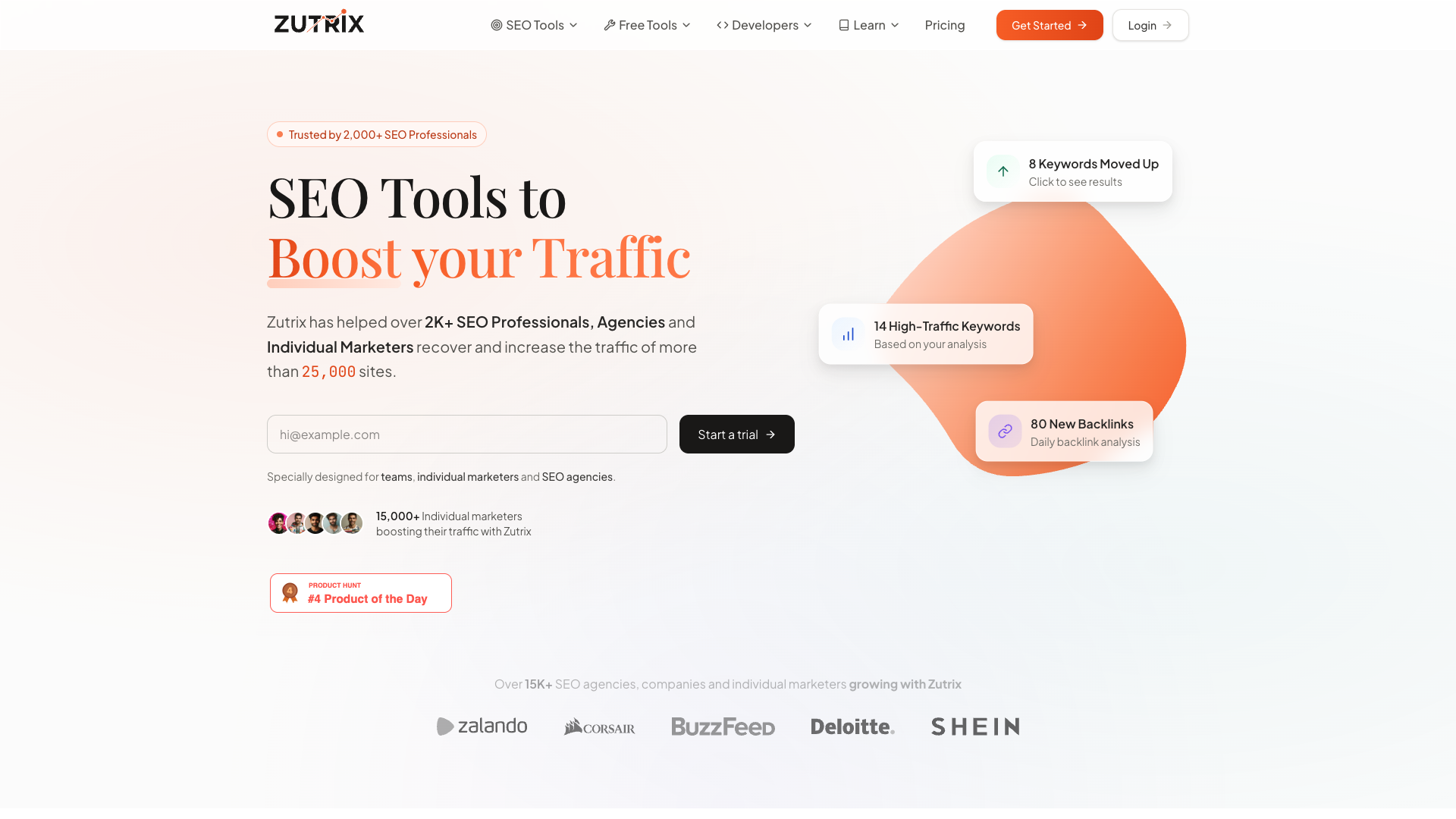
Zutrix is the best value option on this list because it folds AI visibility monitoring into a full SEO and rank-tracking platform, starting at just $9/month.
Where most AI search monitoring tools charge $89–$199/month to do one job (watch AI answers), Zutrix lets you monitor your brand’s visibility across 8 leading AI models and chatbots and track your Google rankings, backlinks, and technical SEO in the same tool.
That matters more than it sounds.
Billed as the world’s first AI-powered Google rank tracker, Zutrix already handles rankings for more than 250,000 sites, and it’s layered AI visibility on top rather than making you buy a second subscription.
You get AI brand monitoring, real-time rank tracking, a Keyword Lab for research, backlink monitoring, technical SEO analysis, competitor tracking, geo-specific results, and white-label reports, with alerts pushed to Slack, Telegram, and email.
For what most tools charge to watch AI answers alone, Zutrix adds a full rank-tracking and SEO suite on top.
For a solo marketer, in-house SEO, or a small agency that wants to start tracking AI visibility without a $200/month line item, nothing else here comes close on cost.
To be fair, Zutrix is newer to the AI-visibility space than dedicated tools like Profound and Otterly, so if deep prompt discovery or granular sentiment analysis is your primary job, the specialists go further. But if you want AI monitoring plus a real SEO suite in one affordable place, Zutrix is the easiest tool on this list to say yes to.
Key features:
- AI visibility monitoring across 8 leading AI models and chatbots.
- AI-powered Google rank tracking with real-time, location-independent results.
- Keyword Lab for keyword research (search volume, difficulty, CTR).
- Backlink monitoring with toxic-link detection.
- Technical SEO analysis and site monitoring.
- Automatic competitor tracking plus geo-specific and local rank tracking.
- White-label reporting and alerts via Slack, Telegram, and email.
- API access with daily data updates.
Pricing:
- Starter ($19/mo): 2 team members, 250 rank-tracker keywords (weekly checks), 50 Keyword Planner lookups, 5 Content Editor credits, 10,000 backlink rows, 100 site-audit pages, 25 Site Explorer lookups.
- Pro ($49/mo): 3 team members, 1,000 rank-tracker keywords, 100 Keyword Planner lookups, 10 Content Editor credits, 25,000 backlink rows, 200 site-audit pages, 50 Site Explorer lookups.
- Agency ($89/mo): 10 team members, 2,500 rank-tracker keywords, 250 Keyword Planner lookups, 20 Content Editor credits, 75,000 backlink rows, 500 site-audit pages, 100 Site Explorer lookups, plus Enterprise white-label.
- Enterprise ($149/mo): 20 team members, 10,000 rank-tracker keywords, 400 Keyword Planner lookups, 50 Content Editor credits, 150,000 backlink rows, 750 site-audit pages, 200 Site Explorer lookups, plus Enterprise white-label.
AI Search Visibility, Content Tracker, GMB local-pack tracking, on-demand custom reports, and embeddable widgets are included on every plan.
You can try the Agency plan for 7 days for $7
2. Profound
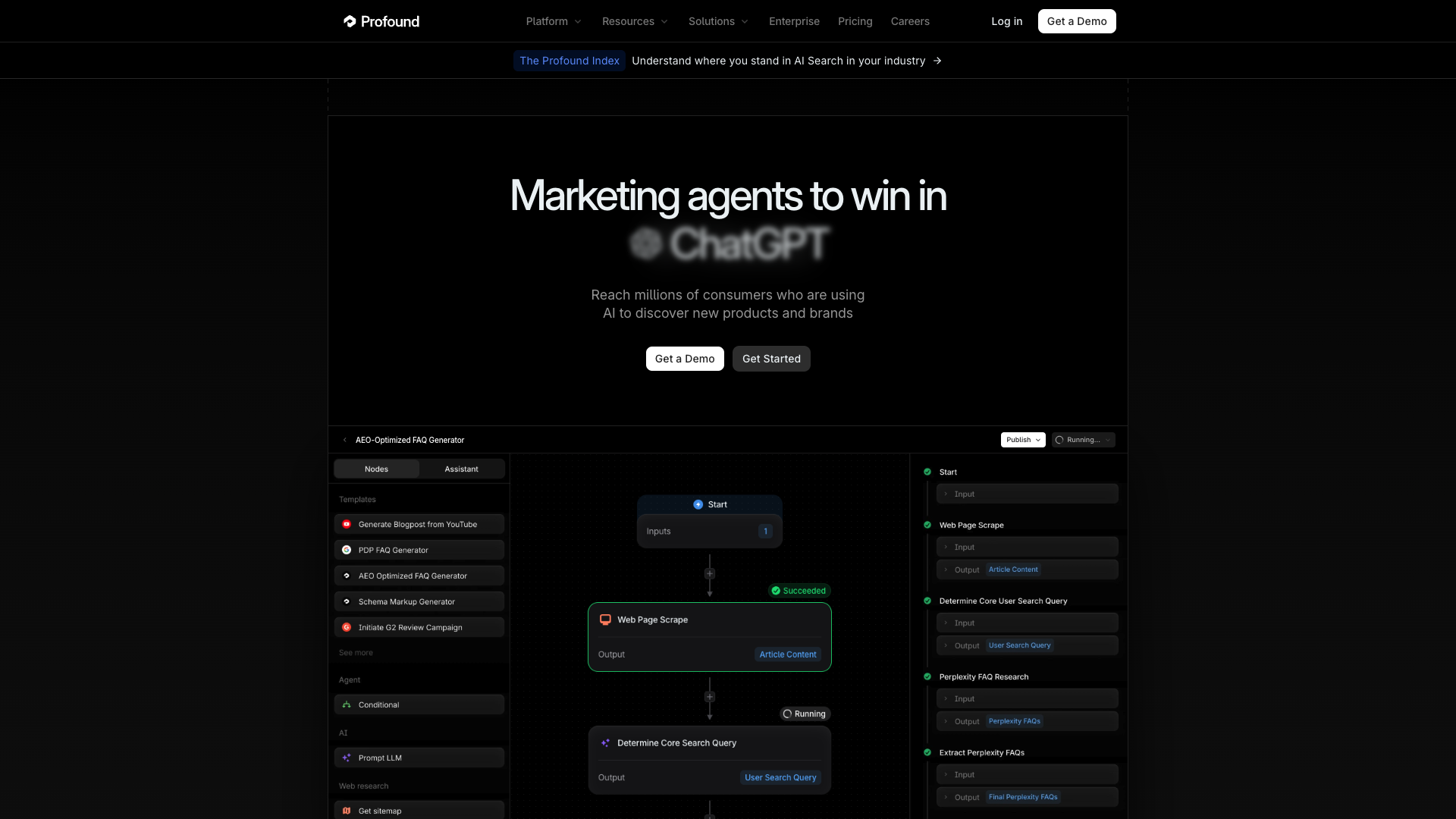
Profound is the tool to reach for when AI search visibility is a boardroom-level priority, and you have the budget to match.
It’s an enterprise-grade LLM analytics platform that tracks how your brand shows up across ChatGPT, Perplexity, Google AI Overviews, and Microsoft Copilot, with some of the deepest answer-level and citation analytics in the category.
What sets Profound apart is depth.
It goes beyond “were you mentioned” into which sources shaped the answer, how conversations unfold, and how AI agents interact with your content. the kind of granular data large brands need to defend visibility across thousands of prompts. That’s why it lands on nearly every serious GEO team’s shortlist.
For a lean team, Profound is overkill.
The breadth of the platform means a real onboarding curve, and full coverage isn’t cheap.
But for enterprises treating AI search as a strategic channel, it’s the most powerful AI visibility tracker here.
Key features:
- Brand visibility tracking across ChatGPT, Perplexity, Google AI Overviews, and Microsoft Copilot.
- Answer Engine Insights into how AI responds to your category’s questions.
- Citation analysis showing which sources shape AI answers.
- Agent analytics and AI crawler/bot activity monitoring.
- Conversation-level data and topic analysis.
- Competitor visibility benchmarking.
- Enterprise-grade dashboards and reporting.
Pricing:
- Starter ($99/mo): ChatGPT only, 50 unique prompts, 1,500 responses analyzed per month, daily checks, 1 language, 1 region.
- Growth ($399/mo): Adds Perplexity and Google AI Overviews, 100 unique prompts, 9,000 responses per month, daily checks, 1 language, 1 region; free trial available.
- Enterprise (custom pricing): All 10 answer engines (adds Google AI Mode, Gemini, Copilot, Meta AI, Grok, DeepSeek, and Claude), custom prompt/response volume, custom languages and regions, plus ChatGPT Shopping tracking.
3. Otterly.ai
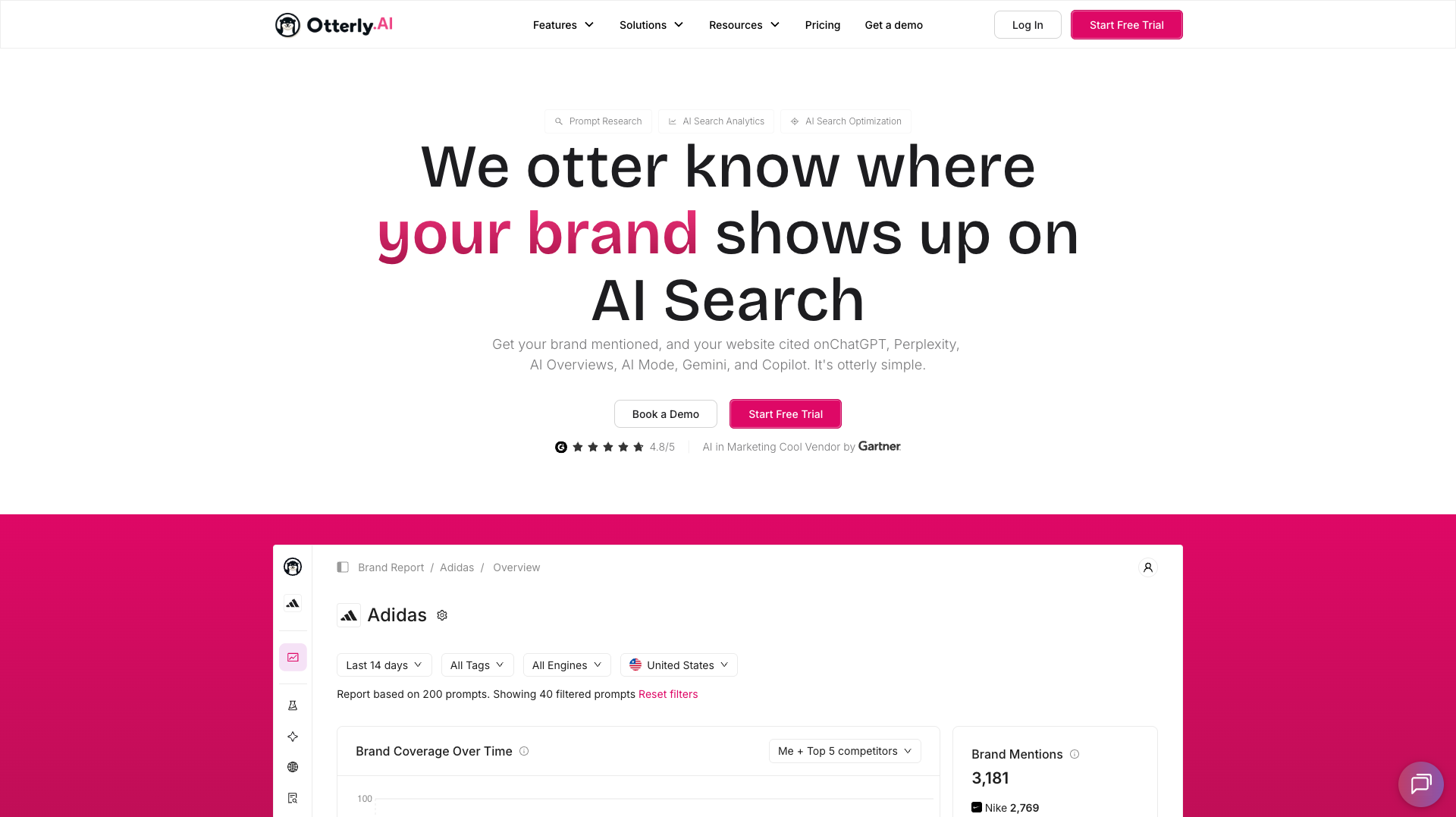
Otterly.ai is one of the original AI search monitoring tools, and it’s still one of the most trusted, used by more than 20,000 marketers and recognized by G2 and Gartner.
If you want a proven, prompt-based tracker without enterprise complexity, this is the safe pick.
Otterly tracks your brand across ChatGPT, Perplexity, Google AI Overviews, AI Mode, Gemini, and Copilot (basically every AI engine that matters).
You build a library of the conversational prompts your buyers actually ask, and Otterly runs them across those engines, surfacing your Share of AI Voice, which brands get cited, competitor benchmarks, and alerts when your mentions shift.
The main limitation is at the lower tiers, the action layer is light. It tells you where you stand well, but it leans toward monitoring rather than prescribing exactly what to build next.
Key features:
- Tracks ChatGPT, Perplexity, Google AI Overviews, AI Mode, Gemini, and Copilot (6 engines).
- Custom prompt library built around real buyer questions.
- Share of AI Voice scoring.
- Linked and unlinked brand mention and citation tracking.
- Competitor benchmarking.
- Sentiment and context analysis.
- Alerts when brand mentions change.
- GEO audits, crawlability checks, and content briefs.
Pricing:
- Lite ($29/mo): 15 search prompts, 4 core engines, unlimited team members, daily tracking (for solo marketers and small teams).
- Standard ($189/mo): 100 search prompts, 4 core engines, unlimited team members, daily tracking, API access, and MCP; add 100 extra prompts for $99.
- Premium ($489/mo): 400 search prompts plus everything in Standard (API access, MCP, unlimited team); add 100 extra prompts for $99.
Claude, Google AI Mode, and Gemini are available as paid add-ons on every plan
4. Peec AI
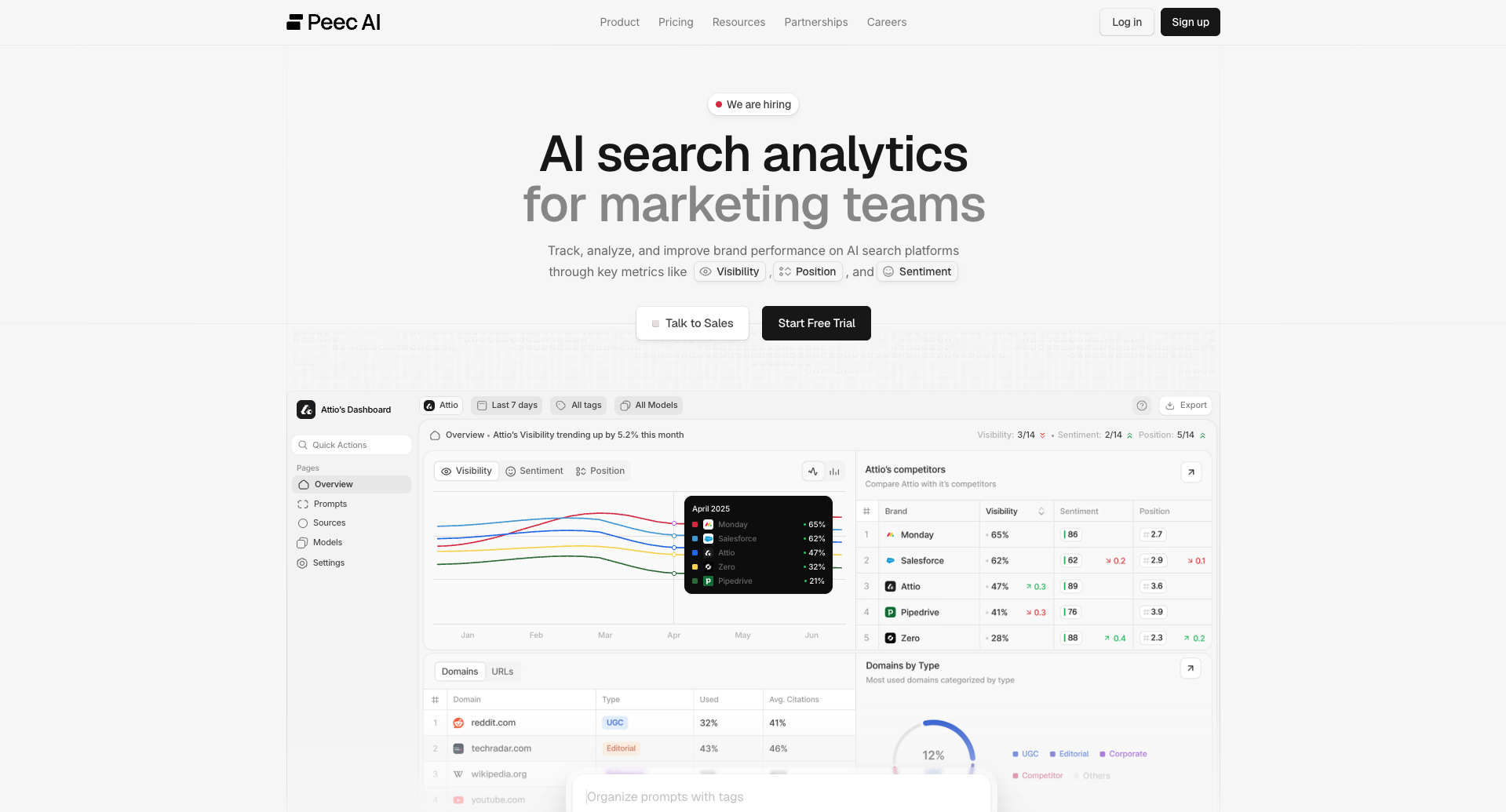
Peec AI is the best fit for agencies, thanks to unlimited user seats on every plan and agency features like client pitch workspaces.
It’s a clean, Berlin-based, GDPR-first analytics platform that’s grown fast, past 1,300 customers, including Wix, Glide, and n8n, inside its first year.
Peec tracks visibility, sentiment, share of voice, and the sources behind AI answers, updated daily, and it uses real browser sessions rather than API calls, so you see the same responses your buyers see.
The unlimited-seats model is the real agency advantage. You can put a whole team and a roomful of client logins in the tool without a per-head tax.
One catch to price out carefully is that the base plan includes three engines only, and adding Claude, Gemini, or others runs roughly €20–30 per engine per month, so broad coverage costs more than the headline.
And like several tools here, it’s monitoring-only. It won’t write or optimize content for you.
Key features:
- Tracks ChatGPT, Perplexity, and Google AI Overviews on base plans (Claude, Gemini, Copilot, DeepSeek, Grok as add-ons).
- Real browser-session tracking (UI scraping) for buyer-accurate data.
- Visibility, sentiment, and share-of-voice metrics.
- Competitor benchmarking via “Add Brands”.
- Citation and source analysis.
- Prompt discovery and suggested prompts.
- Multi-project support and agency Pitch Workspaces.
- Unlimited user seats on every plan.
- Regional and multilingual tracking; CSV export, Looker Studio connector, API (Enterprise).
Pricing:
- Starter ($95/mo): 50 prompts, choose 3 models, unlimited users, daily tracking, 1 project.
- Pro ($245/mo): 150 prompts, choose 3 models, unlimited users, daily tracking, 2 projects.
- Advanced ($495/mo): 350 prompts, choose 3 models, unlimited users, daily tracking, 5 projects, multi-country, and Looker Studio integration.
- Enterprise (custom pricing): everything in Advanced plus all models, unlimited projects, custom prompt setup, daily or weekly frequency, API access, and SSO.
Separate agency pricing available for multi-brand tracking; annual billing offered at a discount.
5. Semrush AI Visibility Toolkit
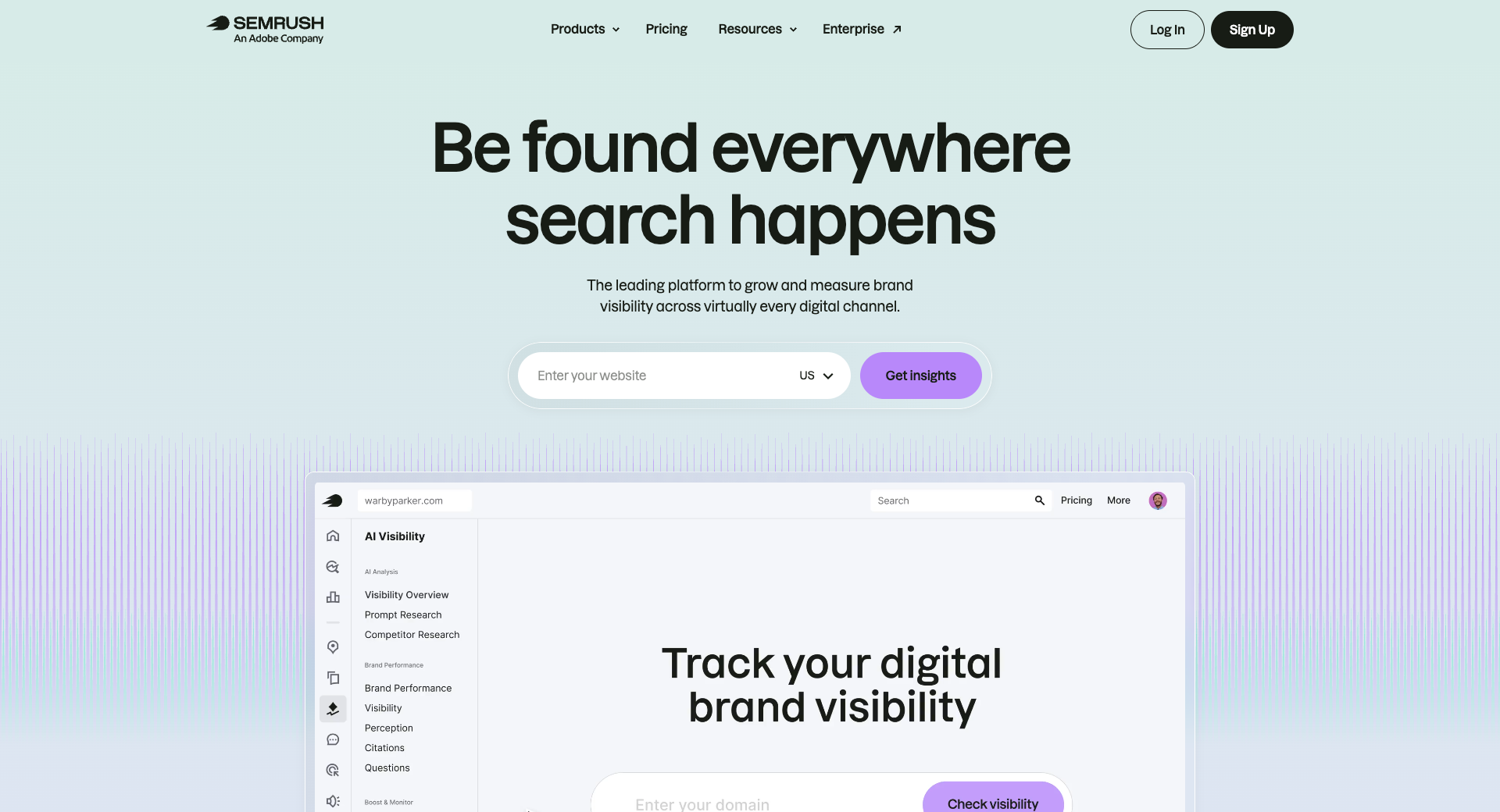
If you already run your SEO out of Semrush, its AI Visibility Toolkit is the path of least resistance. It adds AI search tracking — across ChatGPT, Perplexity, Gemini, Google AI Mode, and Copilot — inside the platform your team already knows, alongside one of the largest keyword and backlink datasets in the industry.
The toolkit tracks brand mentions and citations in LLM answers, compares you against up to 9 competitors, scores sentiment, and includes an AI-readiness site audit that flags technical issues blocking AI crawlers. For teams that want AI visibility and classic SEO reporting in one place, that’s a genuine convenience.
Two honest caveats: the per-domain model gets expensive for agencies tracking several brands (past $500/month quickly), and it’s an SEO suite with AI tracking bolted on, not an AI-native tool — reviewers note the dashboard doesn’t always show which prompts or models produced a score.
Key features:
- Tracks ChatGPT, Perplexity, Gemini, Google AI Mode, and Copilot
- Brand mention and citation tracking in LLM answers
- Competitor comparison against up to 9 rivals
- Sentiment analysis and prompt research
- AI-readiness site audit for AI-crawler access
- Runs alongside Semrush’s full SEO suite (keywords, backlinks, rank tracking, audits)
Pricing:
- Standalone AI Visibility Toolkit ($99/mo per domain): 1 domain, 25 prompts tracked daily; +$60/mo per extra 50 prompts; +$99/mo per extra domain (no free trial; demo reports available).
- Semrush One “SEO + AI Search” Starter ($199/mo): SEO suite + AI visibility together — 5 sites, 500 keywords, 50 prompts tracked daily, 1 AI brand-performance domain, AI-ready Site Audit, MCP access.
- Semrush One Pro+ ($299/mo): 15 sites, 1,500 keywords, 100 prompts/day, plus historical SEO data, content optimization, and multi-location tracking.
- Semrush One Advanced ($549/mo): 40 sites, 5,000 keywords, 200 prompts/day, plus SEO share of voice and API data integration.
The entry SEO-only plan ($139.95/mo) does not include AI visibility.
6. Ahrefs Brand Radar
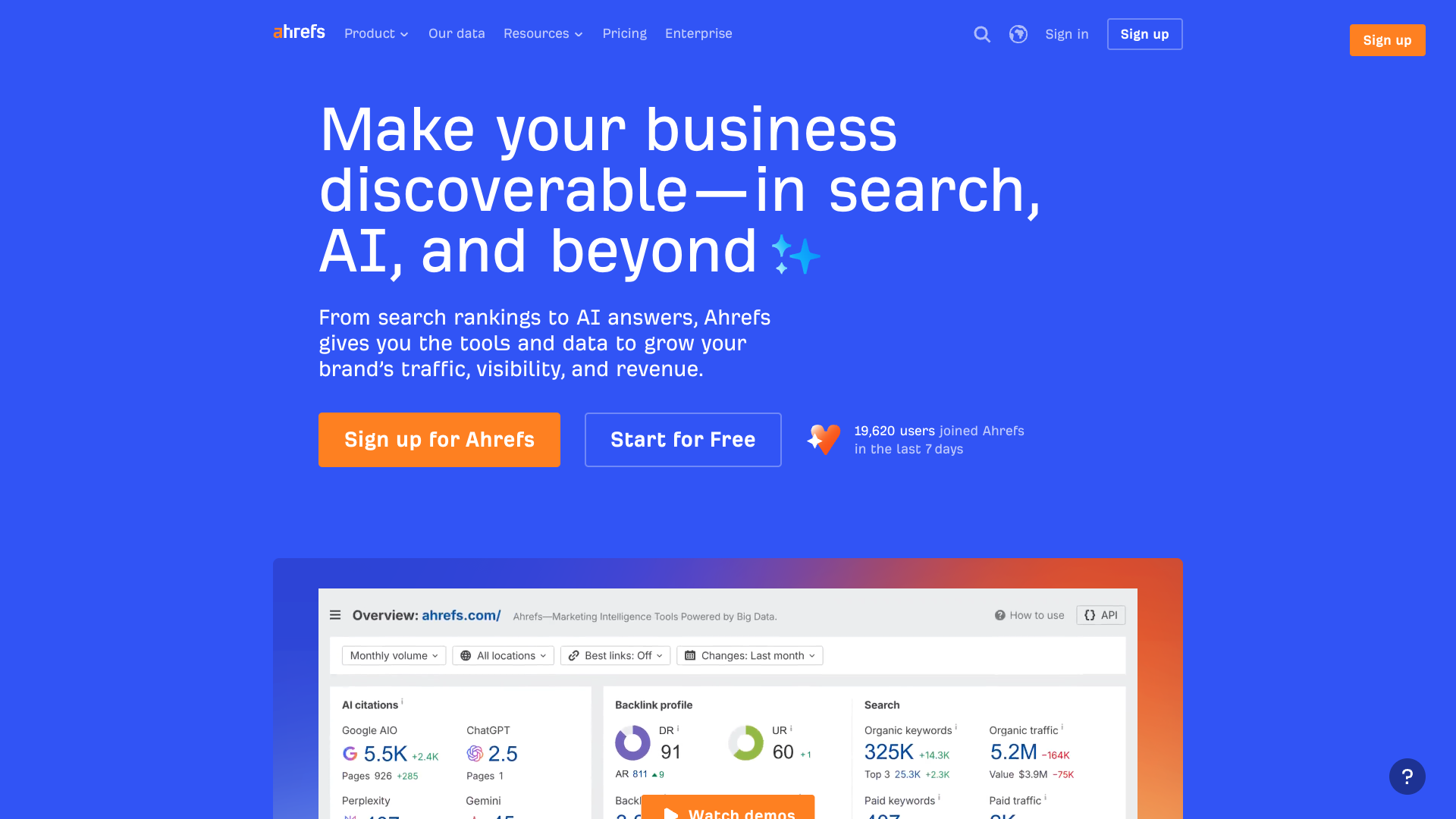
Ahrefs Brand Radar is the obvious add-on for teams already using Ahrefs for backlinks and keywords. It folds AI brand mentions into the same dashboard you already use for traditional SEO, so you can see AI answer visibility right next to your link and keyword data.
There’s a usable free tier that gives a first read on how often your brand appears across AI answers — a convenient way to extend into AI search if Ahrefs is already home.
The trade-off is the same one every retrofitted SEO suite carries: AI tracking is one module inside a tool built for Google rankings, so per-engine depth is thinner than what the AI-first platforms offer. If AI visibility is a side dish, it’s great; if it’s the main course, a specialist will go deeper.
Key features:
- AI brand mention tracking across AI answers, inside the Ahrefs dashboard
- Share-of-voice and brand mention monitoring in AI Overviews and AI answers
- Sits alongside Ahrefs’ backlink, keyword, and rank data
- First-read reporting on how often your brand appears in AI responses
Pricing:
- Lite ($129/mo): 5 tracked prompts, 5 projects, 750 keywords, 6 months of historical data, 100,000 crawl credits, 1 user — Brand Radar (with custom prompts) included
- Standard ($249/mo): 10 tracked prompts, 20 projects, 2,000 keywords, 2 years of historical data, 500,000 crawl credits, plus Brand Radar web visibility
- Advanced ($449/mo): 20 tracked prompts, 50 projects, 5,000 keywords, 5 years of historical data, 1,500,000 crawl credits, plus Looker Studio integration
What to look for in an AI search monitoring tool
The right AI visibility tool depends on what you need to measure, but a few criteria separate the serious tools from the dashboards that just look good in a demo:
- Engine coverage: At minimum, you want ChatGPT, Perplexity, and Google AI Overviews. The better AI search monitoring tools add Gemini, Claude, AI Mode, and Copilot. Check whether extra engines are included or cost more.
- Prompt tracking and discovery: Look for the ability to add your own buyer-style prompts in bulk, plus suggested prompts that surface long-tail queries you’d never think of manually.
- Citations vs. mentions: A mention means the AI named your brand; a citation means it linked to your page. Good LLM monitoring tools track both separately, because they call for different fixes.
- Competitor benchmarking: AI answers are comparative by nature (“best tool for X”). You want to see who’s beating you per prompt, not just your own score.
- Sentiment and context: Whether the AI describes you as “affordable” or “limited” matters as much as whether you appear. Track how you’re framed.
- Alerts and cadence: Daily monitoring and real-time alerts mean you catch a visibility drop the morning it happens, not a month later.
- Action layer: Some tools only watch. The best ones tell you what to build or fix next. Decide whether you need a scoreboard or a playbook.
- Price and scale: Match the tool to your size. A solo marketer and a 40-client agency have very different needs.
AI search monitoring vs. traditional rank tracking
AI search monitoring and traditional rank tracking measure two different things.
Rank tracking tells you where your page sits in Google’s blue links for a keyword.
AI search monitoring tells you whether AI engines mention, cite, or recommend your brand when they answer a question, often before the user clicks anything at all.
The distinction matters because you can win one and lose the other.
Plenty of brands with strong Google rankings get shut out of AI answers entirely, because large language models weigh sources, authority, and context differently than Google’s classic algorithm.
Traditional dashboards can’t see that gap. They track positions, not AI citations.
That’s the whole reason this category of AI visibility tools exists, and increasingly, why teams run both side by side.
FAQs on Best AI visibility tracking tools
What is the best AI search monitoring tool?
The best AI search monitoring tool depends on your size and budget. For most small teams and agencies, Zutrix offers the best value with AI visibility across 8 models plus a full SEO suite from $9/month. Enterprises with deeper needs tend to prefer Profound, while Otterly.ai is a strong, proven mid-market pick.
Is there a free AI visibility tracking tool?
Yes. Ahrefs Brand Radar offers a free tier for a first read on your AI answer visibility, and Semrush has a free AI Search Visibility Checker. Most paid AI visibility tools also offer free trials or money-back guarantees. Zutrix, for example, has a 7-day money-back guarantee, so you can test before committing.
How is AI search monitoring different from SEO rank tracking?
SEO rank tracking measures your position in traditional search results for keywords. AI search monitoring measures whether AI engines like ChatGPT and Perplexity mention or cite your brand in their answers. They’re complementary. A brand can rank well on Google and still be invisible in AI answers, which is why many teams now track both.
Which AI platforms should I track?
Start with the three that drive the most volume: ChatGPT, Perplexity, and Google AI Overviews. If your audience is broader, add Gemini, Google AI Mode, Claude, and Microsoft Copilot. The best AI search monitoring tools cover most or all of these, though some charge extra per engine.
How much do AI search monitoring tools cost?
AI visibility tools range widely. Budget all-in-one options like Zutrix start at $19/month, dedicated trackers like Otterly.ai start around $29/month, and mid-market tools like Peec AI and the Semrush AI Toolkit run roughly $99/month and up. Enterprise platforms like Profound use custom pricing that climbs well into the hundreds or thousands per month.
Final Words
Search has quietly split in two.
The old half, ten blue links, still works, but a growing share of your buyers now get their answer from an AI engine that names three or four brands and moves on.
If yours isn’t one of them, no amount of traditional ranking will save the deal. The best AI search monitoring tools exist to make that invisible problem visible, so you can actually do something about it.
My advice: don’t overthink your first tool. Pick one, start tracking the prompts your buyers ask, and watch where you show up, and where you don’t, for 30 days.
That single habit will teach you more about your AI visibility than any amount of theory.